Thursday, February 24, 2011

Main Mechanic and Level Layout


I talked about the general impressions from playtesters for Tumbleton's Fortune here, but now I want to discuss 2 specific issues that I received good feedback on - introducing the main game mechanic to the player and level layout.

Right at the start when the player is introduced to the main gameplay mechanic of attaching powerup objects to anything in the level, the first puzzle doesn't communicate the full scope of that well.

The problem is that one puzzle is not enough to explain to the player how the mechanic works. While the mechanic seems simple, there's some small quirks to explain to the player. Things like

a) You can't attach the powerup objects to the player ball
b) Once you attach an object to the environment, you can click on it again to reposition it
c) When the puzzle is complete, the object is rendered useless and the player is unable to pick it back up
d) The objects can be attached anywhere in the environment - floors, walls, ceilings, etc.

Communicating all of these in one puzzle would be really intimidating for the player. Instead, having a level composed of small puzzle that focus on each of these bulletpoints would make the experience simple and intuitive.

A couple playtesters also mentioned that the space where the ball (the main character, Tumbleton) rolls is a little too big. More interestingly, one playtester mentioned that it's not the large space that's the problem, but that there's no carrot dangling in front of the player to lead him along! I thought it was a very curious observation, and I'm inclined to agree.

Each level is made up of what I call pieces - things like platforming sections, puzzles, enemy encounters are all pieces. It's my job as a level designer to match and position these pieces throughout levels to give the player an enjoyable and fun experience.

What the playtester is suggesting is some visual way to link these pieces. Instead of rolling down a long ramp from piece to piece, a better solution would be to guide him. Since Tumbleton's Fortune is all about finding treasure, the treasure itself will play a large role in this. Players will be led by the thought of finding more treasure.

Another way to lead the players could be by making more interesting scenery pieces that the players traverse. If a player just completes a piece and is moving towards the next one, there should be something cool up ahead that catches his attention - something like a huge pyramid, or a light in the distance.

I don't want to completely get rid of these parts, because I don't want to constantly throw challenges at the player. After a player solves a puzzle, there should be a short platforming section where they get to experience the joy of rolling and jumping around.

Monday, February 21, 2011

Tumbleton's Fortune playtest session #1 feedback


Last Wednesday marked my senior's game first official playtesting session. Sure, people tested Tumbleton's Fortune earlier while it was in development, but it was mostly me asking them specific questions like how movement felt, were the levels too big or small, and what did they think of game mechanic A, B, C, etc.

This time was different - I set the game up at our 2 designated stations and started inviting people to come check it out. Overall, the feedback was mostly positive which to my delight was better than I expected.

Our main game mechanic involves players picking up powerup objects, and then attaching them anywhere in the level. Getting players to understand how to use this mechanic and what they can do with it is a hugely important task. If players can't understand it, they won't enjoy the game, and won't be able to get past some of the later levels, no matter how good they are at platforming sections.

For our first official playtesting session, I chose to take a more freeform approach of not explaining everything to the player. I wanted to see if the mechanic was easy enough for players to figure out by themselves. I believe that the simplicity of a gameplay mechanic is closely tied with how "sticky" it is - how fun and intuitive it is to use. If a game revolves around a mechanic, it better be sticky, otherwise players will put down your game.

Once the players pick up a large, green and spinny powerup object (it will have particle effects emanating from it eventually so it will be impossible to miss), a message pops up on the screen: "You have picked up an object! Click on it and use it to help you cross the gap".

And that was it. It was up to the players to figure out that you can click the object icon in the player's inventory on the bottom right, position it on the screen, and place it.


Most players quickly figured it out after trying a couple things. A joyful "Aha!" moment followed their success which made me smile. Interestingly enough, after rolling across the bridge object that they just placed, none of the playtesters attempted to pick up the bridge object and reposition it or place it somewhere else. It's true that I never mentioned that you can do that, but in player's minds, once they used up an object to come up with a solution, they forgot about it.

Obviously, the directions won't be so ambiguous in the final version of the game, but it was a nice experiment into the psyche of new players.

A couple playtesters weren't sure that the object attachment worked anywhere on the environment, some thought objects could only snap to the ground. The 2nd puzzle where you have to attach platforms to a wall to vertically scale it aims to teach them that, and putting some text explaining that you can attach objects to a wall would solidify it.

Because of this however, I'm leaning more towards locking the object down after a puzzle that requires it is complete.


The movement of the ball (Tumbleton) was hailed as just right by almost everybody, which made me breath a sigh of relief. I spent a lot of time tweaking things like movement speed, velocity, friction, stopping speed, jumping height, and the general feel of the ball. It felt great knowing it paid off.

More importantly, players said that controlling the ball just felt fun. They enjoyed rolling and jumping around, which is a testament to the controls being sticky.

Multiple playtesters complained about how jerky and fast the camera rotation was, an issue I suspected they would bring up. I relayed this information back to the programmers and we quickly smoothened out camera rotation.

We had a similar issue earlier in development when zooming in or out the camera. You don't want the camera to zoom via clicks - fast movements in or out. Instead, you want to smoothen it out so it has more of an analogue feel, similar to how most RTS games do it. We fixed that early on, and I suggested that we also do the same thing for camera rotation while we were at it, but we put it on hold at the time. I'm glad the problem is finally fixed.


Since the game is a mix of platforming and puzzle solving, some players said that it was kind of a bummer that after having so much fun jumping around and navigating the terrain, they had to stop and figure out how to solve a puzzle. I think they said that because this was the beginning of the game, and they quite didn't know how to play it yet. In later levels, I anticipate players going through the levels in a more quicker pace.

This reminds me of the flow in Mirror's Edge. Subsequent playthroughs of the game were always more fun than the first because you knew where to go and where to jump, which helped you keep the flow and speed of the game going.

Some playtesters also complemented our graphics technology like the bump mapping and shadows, a nod to our graphics programmer. Even though most of the textures in our game are placeholder (they look too realistic), it's still nice to know that the technology is there.


In the end, Tumbleton's Fortune playtest session #1 was a huge success, and I'm looking forward to doing more of these in the future.

Introducing Tumbleton's Fortune

Tumbleton's Fortune is a 3d platformer with puzzle elements set in sandy Egypt. Players navigate the world and solve puzzles by attaching various objects to the environment.


2011 is my senior year at DigiPen as a BSGD (Bachelor of Science in Game Design), and I wanted to challenge myself both as a level and systems designer. I proposed the game idea to my 2 programmer friends, and we quickly formed a team for game class.

In Tumbleton's Fortune, players take control of Tumbleton, an adventurer exploring the mysterious Egyptian land in search of treasure. Tumbleton is a cute rolling ball smiley face with one of those sweet Indiana Jones-like explorer hats. Currently, we're just using an orangish sphere as a placeholder, but it will soon be replaced by an actual model. As you might have guessed, the Tumbleton's Fortune game title is a play on Naughty Dog's Uncharted: Drake's Fortune, one of my favorite new game series this generation.

The game is essentially a 3d platformer - you roll around and jump on various platforms. There's moving platforms, fire that burns you, bumpers and other crazy obstacles that you must navigate around.


However, there's a twist! The puzzle mechanic kicks in when the player picks up one of the many powerup objects scattered around the level. Powerup objects come in different varieties, but the simplest one is just another platform. Players can then choose to take the platform object and stick it to anything in the environment! And by anything, I mean anything as long as it doesn't clip through Tumbleton himself.

In later levels, players will be able to carry multiple powerup objects at the same time, using them in unison to solve challenges. Objects are stored in a small inventory on the bottom right of the screen.

The first puzzle that the player encounters is a huge gap that is too big to jump across. At the front of the gap is our powerup object. The player picks up the powerup, and attaches it to the opposite end, essentially creating a bridge that he can roll across. Nice and simple for the first puzzle and it will help players get familiar with how the object powerup mechanic works.


The second puzzle is an extension of the first one. Instead of placing a bridge across a gap, players will have to place 2 smaller objects in a vertical fashion to scale a wall that is too tall to jump over.


That's how puzzles in Tumbleton's Fortune work. Me and the team are still undecided whether to take away the objects from the player once they use them to complete a challenge. There's 2 sides to this issue:

On one hand, it's cool to always have an object that you carry throughout the level with you, similar to the beloved Companion Cube in Portal - it creates attachment with the players which is a powerful emotional connection.

On the other hand, if players just pick up all the objects after solving each puzzle, they can use them to potentially break how levels work, or even skip huge portions of levels.

A solution we're considering right now is to allow players to carry certain smaller objects with them throughout the level. As long as the objects aren't huge, players won't be able to use them to cross gaps and go where they shouldn't be allowed yet.
For all other objects, once the player uses it to complete a puzzle, he will be unable to pick it up again.

So platforming and solving puzzles with powerup objects is what Tumbleton's Fortune is all about. I'll dive into the types of these powerup objects and what you can do with them in a future update.

Sunday, November 28, 2010

UNCHARTED 2 MULTIPLAYER NOTES

I've been a huge fan of Uncharted 2 multiplayer ever since playing the beta, and after actively playing the multiplayer ever since the game's release a little over a year ago, I'm ready to give some of my thoughts.


Essentially a 3rd-person cover shooter, Uncharted 2 offers more freedom to players than similar games like Gears of War. Instead of just going from cover to cover, the characters can jump and climb around the map, adding an aspect of verticality to a traditional cover shooter.

The competitive modes feel balanced fairly well, with no weapon combination overpowering others - each weapon is good for a certain situation. Each player can have 2 boosters on their character, Uncharted's version of perks from Call of Duty. Below are some observations I've made regarding weapons and boosters:

WEAPONS AND TOOLS

GAU-19: A very loud chaingun, players know where you are immediately the minute you start firing one because

a) the sound can be heard pretty much anywhere on the map and
b) it's always in the same set location on the map, meaning that as soon as players on the enemy team hear you firing one of these, they're going to instantly know where you are

The GAU is only useful in situations where enemies are grouped up near the gun, which doesn't happen often. Even if you have direct line of sight to an opponent across the map, he'll either roll out of the way or kill you.

Riot Shield: Protects you from bullet fire from the front, but seriously slows down your movement speed. I find the shield useless because a grenade toss can easily eliminate a person with a shield, and the grenade doesn't even have to land behind the shield. The enemy can also easily run around you and kill you from behind before you can turn around quick enough. Because of the nature of the game, mobility in Uncharted 2 is always more important than protection.

BOOSTERS

Competitive multiplayer also offers boosters, which are perks that players can use to help them have a certain edge (like in Call of Duty). Things like starting off with an extra grenade or having more pistol accuracy. You buy all these with the money that you earn from matches. Top players can choose to purchase Badges of Honor, which act like negative boosters, providing a disadvantage. In return, every 5 kills they get will net them a nice XP bonus, creating a risk/reward structure. These range from having half health to a carrying half a loaded clip to the worst one that lets enemy players see your name through walls, acting as quite an ego boost.

Below are my thoughts regarding some specific boosters:

Break Up: Lets players destroy destructible objects faster. Useless because the only destructible objects that act as cover are a few wooden boxes (which aren't good cover anyways) that are found in a few maps. Propane tanks and generators can be destroyed easily without this perk with a few extra bullets, which is not a problem if you have an automatic weapon, and everybody starts off with an AK - an automatic weapon. If the maps were designed to offer more destructible cover, I could see this booster being useful, but as of right now, it's just a waste of a slot.

Hell Blazer: Move faster with the GAU-19. Still not fast enough to be of any use. Plus, a player has to get to the GAU first.

Turtle:
Move faster with the Riot Shield. Moving faster isn't really a big boost if players using shields die from grenades most of the time. If this booster allowed the riot shield to withstand a grenade blast up close, I could see it being useful for players that like the shield. Also, it has the same issue of the player getting the riot shield first to be useful.

Once again, a big negative of the above 2 boosters is that they're too specific and not worth the booster slot when there's better ones available that always offer a passive bonus.

There are other specific boosters like Rocket Man and Launch Man which increase the ammo of the game's most powerful weapons - The Hammer and the RPG, but those are worth it because both weapons are the most powerful in the game, netting easy kills.

Situational Awareness:
The player can stop and with the press of a button, see close-by enemy player names through walls. This booster breaks elimination games, where the goal is to eliminate the opposing 5 player team, offering no respawns when players get killed.

The thrill of elimination games comes from a cat and mouse hunt metagame. If there's 1 or 2 enemy players left, you can just find them using this booster instead of carefully trying to spot them, all while worrying about your safety, offering no thrill or challenge. I've had situations where me and another player on the opposite team were the last ones left and we both had Situational Awareness. Afraid to attack each other, because we both knew where we were, the match usually resulted in a tie.

Evasion: Immunity to Situational Awareness. I think having a booster that nullifies another one is a poor design decision, as each one of them should offer something positive without having to worry about what perks other player are using. Modern Warfare 2 did this even more, and I didn't like it either. It ended up being a stacking game to see who's perk can negate what. Perks and booster should be used to enhance your play, no matter what other players are using.


POST-LAUNCH SUPPORT

Naughty Dog
has been providing excellent multiplayer support, releasing DLC packs with new co-op modes, multiplayer maps, and skins. An interesting thing that they've starting doing is a gameplay mode that changes every weekend called The Lab, which acts similar to Left 4 Dead 2's mutation modes - offering a special randomized gameplay type. Modes like Pistols and Grenades only, RPG's only, or team 3 vs 3, instead of 5 vs 5 keep the multiplayer competitive scene fresh with new and interesting options. Variation never hurts.

During many holidays such as Christmas and Thanksgiving, Naughty Dog has also been doubling the amount of XP players can earn, enticing players to play more during these weekends. One weekend even had 5x XP! After that, everyone that I played online with seemed high level.

Occasionally, you can also spot a Naughty Dog employee in a game with a red paw next to their name. It's always cool to see developers playing together with their players, supporting the lifecycle of the game.

MAXING OUT

The max level cap in multiplayer is really high and while it's a nice goal, average players will never even come close, as it takes way too much XP to level up starting around level 45. I think doing something similar to prestiges in Call of Duty would have been a better option. On top of that, Naughty Dog raised the max level cap twice - to lvl. 70 and then 80, making reaching the end even more insurmountable.

BALANCE CHANGES

Even though I enjoyed the multiplayer of Uncharted 2 through all the patches, Naughty Dog has been changing multiplayer balance a lot since game launch. At the start, players had more health. Then a patch made everyone weaker so people weren't so bullet-spongy anymore. However, players complained that everyone was too weak and eventually, player health was raised a bit, although never as high as before.

Same goes for grenade damage and radius - it was adjusted multiple times. At launch, grenades were too powerful and they were patched to be weaker. However, they became too weak, and thanks to complaints, their explosive radius was extended.

I understand that a game is always evolving, and it's good to listen to your community and let them playtest the game, but when you have to make such drastic changes multiple times, it becomes dangerous and you risk alienating some of your user base.


QUIT PENALTIES

Another thing that was added post launch were penalties for match quitters. Quitting a game in-progress drastically affects your team since there are only 5 players on a team. To combat quitters, a solution was put in place where the 1st quit would give the player a timeout penalty of 30 secs. During this, you can't do anything but sit and watch the countdown clock tick down. This is a bad decision. There's nothing worse for players than to have their valuable time taken away, even if it is just a measly 30 secs.

The 2nd time you quit, you forfeit some XP, which I have no problem with. In my opinion, players should forfeit their XP just for quitting the 1st time, not their time. The 2nd time quitters should be demoted a level.

If you can't play a 15 minute match, then don't - simple as that. Wasting XP is totally fine, just don't waste my precious time!

ELIMINATION MODE

In Elimination, my favorite multiplayer mode, players don't respawn after they go down. Whichever team eliminates all the opposing players scores a point. First to 3 points wins. This is similar to Counterstrike matches and the Search and Destroy mode in Call of Duty: Modern Warfare.

What really breaks the Elimination games (besides the Situational Awareness booster) are the power weapons like the Hammer and the RPG.

Having these weapons be there during Elimination games is both a pro and a con. On one hand, you have guaranteed chokepoints - spots that players will meet at, resulting in conflict - something that designers strive to make happen in a multiplayer game.

On the other hand, whoever grabs the weapon first has a good chance of winning because the RPG and the Hammer are very easy to get kills with.

If you decide to not go for the power weapons and play the game your way, you're already at losing odds, because whoever gets the power weapon has a huge advantage on their side. This makes it so that you pretty much must go towards the power weapons and pick it up out of fear that the other side will do it.

It would have been cool to see a vote on whether to have power weapons in elimination games, much like a map vote before the game starts.

Overall though, playing Uncharted 2 online has been an absolute blast and I would say that it's my favorite online game on the PS3. Since launch, players have seemed to get better and better, upping up the competition, especially if people are playing together in parties. With around 35k players playing worldwide every night, it's a healthy community of players that I am happy to contribute to.

Sunday, October 31, 2010

DESIGN REVIEW: Fallout 3 - Operation Anchorage

Operation Anchorage added what every expansion pack should - new missions, characters and items. However, on top of that it changed previously established core mechanics: player healing and obtaining ammunition.. Having the expansion pack take place in a simulation has its pros and cons, but for the most part, it provided a good change of pace.

LIKED:
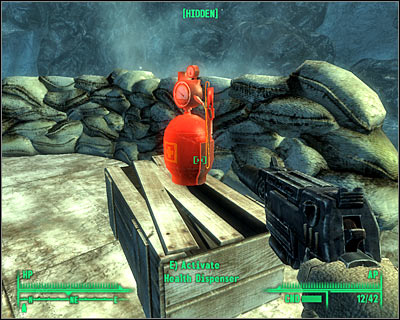
- Old Mechanics Born Anew. The majority of Operation Anchorage takes place in a simulation, much like one mission in Fallout 3. Because of this, Bethesda was free to implement a new health and ammunition recovery system. Unlike in Fallout 3, the player can't hoard stim packs and ammunition - instead, health and ammo is replenished by stationary canisters scattered throughout the game world.

Because of this, every enemy encounter is much more serious. You can't simply pull up your pip-boy and heal yourself in the middle of a gunfight - you must survive the encounter and get to a health station to recover health. This is a nice way of balancing things out for a high-level player - all the player's items are stripped upon simulation entry and he has to get used to core game mechanics, now unfamiliar to him. It's almost like playing the game for the very first time again.

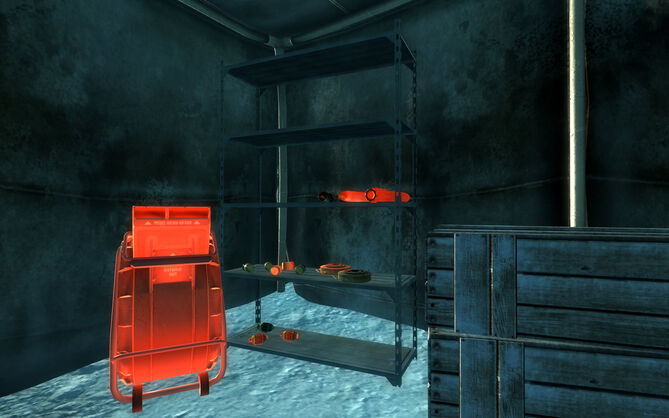
Searching is also non-existant - players can't search anything in the simulation, save for certain items that flash red. Dead bodies evaporate, giving you no time to ransack your defeated enemies for ammo and other goodies. This isn't necessary a bad thing, just another change to the main gameplay. Whereas in Fallout 3, I would search every nook and cranny of a room, here I just ran through, fighting enemies and never looking back. It provided a breath of fresh air for highly methodical players like me.


- New Environment. Having Operation Anchorage take place in a blue, snowy, and mountainous Alaska is a stark contrast to Fallout 3's post apocalyptic green-tinted wasteland. It provided a nice breath of fresh air for someone like me who has played the game for a long time.


DISLIKED:
- Disjointed and Unconnected. Because Operation Anchorage is a simulation, it's even more separated than other missions in the game. Once complete, the player is unable to revisit the simulation and replay it. All the characters that the player met in the simulation are gone, and while the game does reward you with some items that you used in the simulation upon completion, it doesn't give you all of them. Once the player loses or breaks these items, there's no way to get more.

Having taken place many years ago before the Fallout 3 game timeline, the player is unable to meet the characters in the simulation once he gets out, and is generally unaffected by the events of the entire expansion pack once he completes it. This lessens the effectiveness of Operation Anchorage as a whole, acting as a quick and temporary thrill, never to be relived or remembered again.

Wednesday, May 5, 2010

DESIGN REVIEW: Far Cry 2

Far Cry 2 struck me as a very ambitious open world FPS game experiment. There's tons of small features and details in this game that elevate it above other games in its genre, but there are also surprisingly simple, yet vital details that the designers didn't quite implement correctly. If time was spent on those details, I strongly feel that FC2 could have easily stood with the best games of the year and acknowledged by the public for its interesting features instead of publicly being considered just 'good'. All the details complement each other and contribute to what I feel the theme of the game is - improvisation.

LIKED:
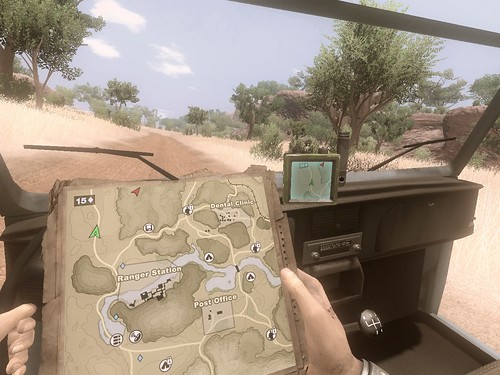
- Map Navigation. The map screen in FC2 is simple to use and navigate. Instead of pausing your entire game while you look at the map, the protagonist simply pulls out a map in real time and looks at it. Just this little piece of detail brings you closer to the main character and makes you believe you are him (you can select out of 7 male characters which has no real gameplay impact, and I remember reading they had to cut the women as playable characters!). As you're looking at the map, you are staring through the protagonist's eyes, which is really cool for such a small detail. This features adds to the general theme of the game - improvisation. If you're driving a jeep and being chased by a bunch of bad guys at the same time, you better know how to drive and read a map at the same time! With a few button presses, you can easily toggle the zoom level of the map, which translates to the protagonist pulling out another map out for you using beautiful animation. The maps contain everything that you need and expect like mission objectives, enemy outposts, and even collectibles that you have found.


- Weapon Jamming. On one side, it's cool to see weapons slowly degrade with actual cosmetic changes that you can observe like rust and dirt. This mechanic makes you pick up weapons on the fly, once again contributing to the overall theme of improvisation - many times while you're engaged in fierce combat. One the flip side, every weapon that you pick up from the bad guys is in pretty terrible shape, meaning that it will be useless very soon, in some cases before you can even get done with the current firefight, causing you to scramble for yet another weapon. It's not so much fun wildly running around to find a usable gun - any gun while getting shot at from all directions (thanks to the hawk-eyed AI). All is not bad however, as there are weapons that you find in crates which start in perfect condition and deteriorate from there. I may be on the fence regarding this feature, but this mechanic works excellent in the grand scheme of things of improvisation.


- Fire Spread. The fire propagation in FC2 is the best out of any video games I've seen. Many weapons, some obvious like flamethrowers and Molotov cocktails, others less so (certain explosions) start a fire in the savanna grass which grows for a certain amount of time and area. The direction is uncontrollable by the player, adding an interesting random element, but goes with the wind, making it very realistic. Many times, the fire turns back on you, forcing you to quickly think on your feet. Once again, the random an uncontrollable fire propagation in FC2 welcomes... you guessed it improvisation with open arms. This is a very interesting Gamasutra interview with the programmer responsible for the fire implementation.


- Amazing Atmosphere. Seeing the sun go down in FC2 is a really beautiful moment. The shadows jump around the jungle realistically, and the world slowly turns dark. But it's not just the graphics that make the atmosphere good, it's all the little details - game map, individual vehicle dashboards, and architecture all help make up the atmosphere.

- Something New. Emphasizing actual (or similar to real) conflicts that are happening in Africa - the chaotic nature of civil wars, FC2 is the only game that does it, and for that, I applaud the developers for trying something new and the publisher for green-lighting it.

- Map Editor. Simply throwings objects onto the terrain which you can manipulate with a variety of brushes makes a very functional map editor. The cool thing is that you can enter the map instantly and play around sandbox style in your own creation. The Xbox 360 and Playstation 3 versions also shipped with the editor, which is unheard of in the FPS console market.


DISLIKED:
- Enemy AI. The AI in FC2 is good, a little too ridiculously good. So good in fact, that it hurts player choice, which is very odd, considering that's what the game is about. Taking a sneak approach always ends up with you quietly taking out 2 enemies, followed by the entire base converging on you... during nighttime. During the day? Enemies can see you ahead, no matter what kind of trees or shrubbery is blocking their field of vision. Like hawks with terminator-like vision, enemy soldiers will spot you from a mile away and open fire. Because of this, all missions pretty much boil down to you walking into an enemy compound with guns blazing and methodically cleaning camp.

This bring me to another negative issue that me and a lot of other players had - death by jeeps! Enemy soldiers can 1 hit kill you with their vehicles, which might be realistic, but not so fun. It's cool the first few times it happens, but you never feel safe ever again (once again, improvisation). There's an audible VROOOOM! sound cue when a vehicle is about to run you over, but it all it does is make the player sprint in a random direction and pray that the vehicle misses you. A lot of times, the AI decides to run you over while you're engaged in a heavy and very loud firefight, giving the player absolutely no time to judge where the vehicle is coming from. I would have liked to see some kind of an equipment piece that the player can buy that pings your map when an enemy vehicle is nearby.

I would have relaxed the AI, making it less accurate (not a 'lower the difficulty issue') because after playing many open world games, I found that having easier AI makes the game more enjoyable for the player. The skill of the AI is always offset by the quantity of enemies.

- Infinitely Respawning Military Checkpoints. Imagine this scenario - you're driving happily across the African jungle on your way to a mission when you come across an enemy checkpoint. No big deal - you kill all the bad dudes and clear the checkpoint, and then drive on through to complete your mission. However on your way back, you have to drive through the same checkpoint, and all the enemies are completely respawned! No matter how many times you clear out a checkpoint, the next time you pass it, all the enemies will be back, ready to gun you down! The fastest way to travel through the game world is by roads which are infested with these enemy checkpoints. If you don't travel by road, it will take you a very long time to reach your destination, making it never worth it. Coupled with the fact that the enemy AI is too good in this game, fighting the same enemies in the same spot becomes a hassle.

I understand why the designers chose to implement continuous enemy respawns at the checkpoints. It's a double edged sword - if there were no respawning enemies, once the player cleared out a checkpoint once, those parts of the game world would get very uneventful and even boring, making the player feel unthreatened and less time in the action. So they chose to respawn the enemies to keep the player on their toes at all times, which adds to the central theme of improvisation.

To fix this problem, I would add an icon for each checkpoint on the player's map that would start a timer as soon as it was destroyed by the player. When the timer expired, the checkpoint would be rebuilt and repopulated by enemy AI. Different checkpoints could have different timers, maybe even all of them being a random value from 10 - 30 minutes. The beauty of this fix is that players could strategically plan which roads to take depending on how much time is left on certain checkpoints.

- Buddies. Buddies are supposed to be a huge attraction of the game, but all they're good for is reviving you on the field of battle after you die. It's nice and gives you a 2nd chance, especially if you're run over by an enemy vehicle, but other than that, all the buddies are EXACTLY the same. There's nothing different about them, save for the model and voice actor - you don't get any unique weapons or equipment for having a specific buddy, no boosts, nothing. They all give you calls after you accept a mission, and advise you to do a mission their way, which is ALWAYS the better (i.e. easier) way to do a mission.

They do however add to the overall atmosphere of the game and the nature of the player meeting new people in an unknown land of Africa, I just wish they had more gameplay value.


- Voicework. I've never been to Africa, but according to this game, everybody there talks REALLY, REALLY fast. Playing the game with subtitles is a must, as you'll constantly miss what your contacts are saying to you. I don't know if Ubisoft was trying to make the game more authentic, with everybody talking so fast, but a lot of characters were lost in the crowd, and proved to be really unmemorable, thanks to them all talking like they're in some kind of a speech race. Interestingly, the characters talked normally in the trailers for the game, making me believe that the new, fast voice work was a last minute change.

Monday, May 3, 2010

DESIGN REVIEW: Wet

Borrowing heavily from grindhouse films and Quentin Tarantino, Wet can't be played like other 3rd person shooters. The correct way to play the game is to jump or slide on the ground as soon as you see some bad guys, which automatically triggers bullet time, giving you easy kills. While a solid experience, this sole mechanic which the entire game is based on overstays its welcome just a bit, making the normal sections of the game tedious at the end. What I really loved were the balls to the wall on the rails sequences like being in a Matrix-like car chase and falling out of an airplane.

LIKED:
- Style. Wet borrows heavily from the grindhouse era of American films. Inevitably, that also means emulating Quentin Tarantino. The dialog is cheesy - just bad enough to be good, the game by default has a film grain filter to it (which you can thankfully turn off), and the characters are all crazy. The most bizarre however, are the classic advertisements you get to view before the start of each chapter, which look to be lifted straight from the movie theaters... 50 years ago. Rubi, the game's protagonist also has the most bad-ass way to climb down ladders I've ever seen in a video game.


- On the Rails Sections. These are the parts where I had the most fun in the game. Exciting and crazy, it really is something to fall 20,000 ft in the air, dodge airplane debris and shoot bad guys. I really wished there were more of these in the game, as they help break up the monotonous nature of the game fairly well.


- Rubi Vision. The world transforms into red, white and black colors and Rubi gets even more badass. Serves for some entertaining enemy deaths as they evaporate into thin air. Also a pace breaker... even though it still closely follows the main game mechanic of using bullet time to kill dudes.


DISLIKED:
- Overused Main Game Mechanic. There's a reason that bullet time should be a commodity, and not be allowed to be triggered freely, anywhere and anytime the player feels like it - if you do it all the time, it loses its special meaning and becomes monotonous. This is a very negative issue for Wet, especially since the entire game revolves around this sole mechanic!